Simple rope bridges offer lifelines for tree-dwelling animals

Across the Amazon, roads and power lines cut through forest that once stretched unbroken for hundreds of kilometers. The resulting fragments pose serious challenges for wildlife. Many species survive by moving through the canopy, yet the gaps created by infrastructure force them to descend to the ground or prevent them from moving between trees. Mortality from vehicle strikes is one risk. Isolation may prove the more consequential one, gradually eroding the genetic health of populations.
Researchers are exploring relatively simple ways to restore some of that lost connectivity, reports Luís Patriani.
In Peru’s Napo-Sucusari Biological Reserve, near the city of Iquitos, two biologists from the State University of New York at Binghamton installed a series of experimental canopy bridges. Nets, ropes and small platforms were suspended between treetops, forming corridors that allow animals to move from one tree to another.
Camera traps recorded the results over several weeks. Sloths, saki monkeys and an Amazonian long-tailed porcupine used the structures, offering a glimpse of how arboreal mammals respond when given a path across the canopy. Such observations may seem modest. For conservation planners, however, they provide useful information about how animals move and which bridge designs they will use.
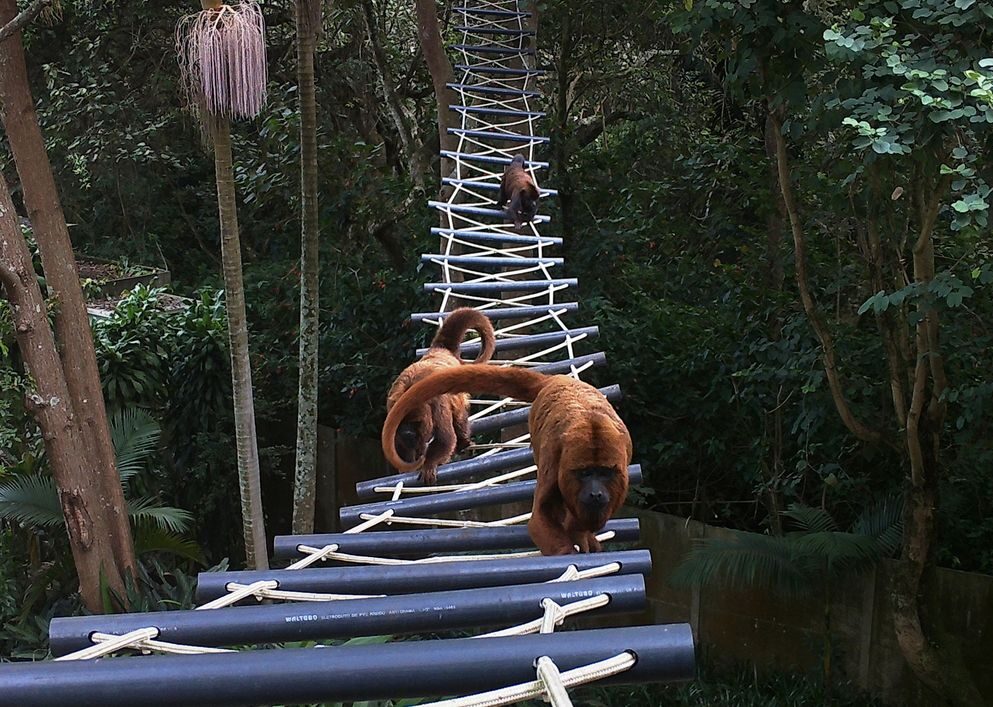
Elsewhere in South America, similar efforts are being tested along highways. In Brazil’s Atlantic Forest, researchers have linked trees with simple rope crossings where primates had been killed attempting to cross roads. Within days, monkeys were using them.
The structures are straightforward and inexpensive. Their value lies in what they restore: the ability for animals to move through forests that infrastructure increasingly divides.
Header image: Howler monkeys using an artificial bridge at Fontes do Ipiranga State Park in São Paulo. Image courtesy of the São Paulo State Secretariat of Infrastructure and Environment (SEMIL).